
“Sleep support” on a label
On a supplement label, “sleep support” describes a structure/function claim about the ingredient, not a promise of a specific outcome for every person who takes it.
Sleep & routine
What research does and does not show about ashwagandha and sleep quality, and how a root-based routine fits without promising outcomes it cannot deliver.
Understanding the terms
Distinguishing traditional use, labeling language, and clinical evidence keeps expectations honest.
On a supplement label, “sleep support” describes a structure/function claim about the ingredient, not a promise of a specific outcome for every person who takes it.
Most published ashwagandha-and-sleep trials are small, run over a few weeks, and use different extracts and doses. That makes it hard to generalize results to any single product.
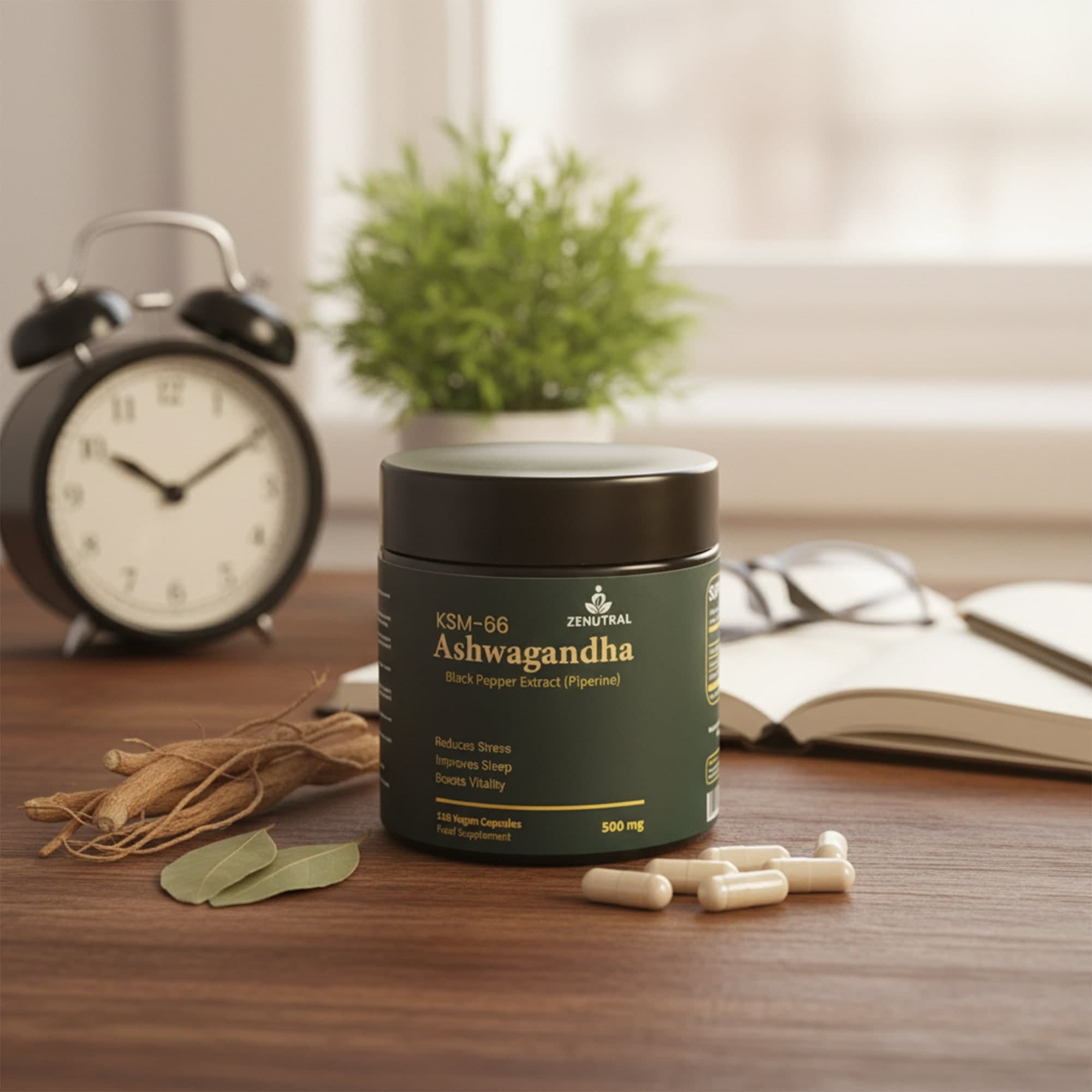
Ashwagandha supplements vary by plant part and extraction method. Zenutral’s current formula uses KSM-66®, a root extract, alongside black pepper extract / piperine.
A supplement is one part of an evening routine, not a substitute for sleep habits like a consistent schedule, light exposure, and winding-down time.
Evidence before headlines
Ashwagandha has been studied for possible effects on sleep quality and stress, most often using small samples and short trial periods with varying extracts and doses. That makes broad promises inappropriate, and it makes conclusions about any single product impossible without direct substantiation of that product.
For an independent overview of the evidence, safety considerations, and medication interactions, read the NIH Office of Dietary Supplements fact sheet.
Common questions
Educational context only—not medical advice or a substitute for guidance from a qualified healthcare professional.
Some small clinical studies suggest ashwagandha extracts may be associated with modest improvements in sleep quality for certain groups, but trials differ in extract, dose, and length, and results do not guarantee an effect for any individual. It is not a sedative and should not be treated as one.
Many people include it in an evening routine, but Zenutral does not provide personalized timing guidance. Follow the product label and ask a qualified healthcare professional if you are uncertain.
Published studies commonly run six to twelve weeks of consistent use. Individual experiences vary, and research timelines are not a guarantee of personal results.
Federal health resources note that long-term safety has not been well established and that rare liver-injury cases have been reported. Anyone considering nightly use, especially with existing health conditions or medications, should ask a qualified healthcare professional first.
Zenutral's current formula lists KSM-66® Ashwagandha root extract as its primary ingredient and Black Pepper Extract / Piperine as its companion, labeled at 500 mg per serving in a 120-capsule bottle.
See the formula
Explore Zenutral’s KSM-66® Ashwagandha formula or return to the full guide library.
Additional public-health reference: National Center for Complementary and Integrative Health.